
How to Memorize the Quran at Home: 11 Proven Tips (Beginner Guide)
9 min read

Can You Really Memorize the Quran at Home?
Yes. You need a clear intention, a steady routine, and a method that protects what you have already learned.
Many people believe hifz is only for children or for students in full-time schools. The truth is simpler. Millions of adults in Saudi Arabia, across the Gulf, and around the world memorize the Book of Allah between work, family, and daily life. They do it one small portion at a time, and they never let a day pass without opening the Mushaf.
This guide gives you 11 practical steps, a sample daily plan, and answers to the questions beginners ask most. Memorizing the Quran is a gift that Allah gives to whom He wills, so ask Him for it, and then take the steps below.
1. Start With a Sincere Intention
Before you memorize a single verse, renew your intention. Ask yourself why you want to do this. The answer should be for the sake of Allah alone, not for praise or for a title.
The Prophet, peace be upon him, taught that deeds are judged by intentions, and every person receives what they intended (reported by Al-Bukhari). A sincere intention keeps you going on the days when motivation disappears, and those days will come.
Try this today: write one sentence that explains why you want to memorize the Quran, and keep it inside your Mushaf.
2. Make Dua Your Daily Companion
Hifz is a gift from Allah, so ask Him for it directly. Make dua at night, in sujood, and at the times when supplications are most likely to be answered. Ask Him to make the Quran the spring of your heart and to make memorization easy for you.
Do not treat dua as an extra. It is the first tool of every successful student.
3. Build a Daily Habit and Stay Consistent
Consistency beats intensity. Ten minutes every day will take you further than three hours once a week.
Think about Surat Al-Fatihah and the words of the tashahhud. You never sat down to memorize them. You simply repeated them in every prayer, day after day, until they became part of you. The Quran works the same way. What you touch every day stays in your heart, and what you leave for a week begins to fade.
Start small and make the amount easy to keep:
• Beginners: a few lines a day.
• Steady learners: half a page to one page a day.
• Advanced students: one page or more, plus a larger review portion.
Then raise the amount slowly. A small daily habit that you keep is better than a big plan that you abandon after a week.
4. Listen to a Skilled Reciter First
Your ear is your first teacher. Before you try to memorize a page, listen to it several times with a reciter who has strong tajweed and a clear voice.
Choose one reciter and stay with him, so your mind learns one rhythm. Many learners enjoy the slow, teaching style of Sheikh Mahmoud Khalil Al-Husary, the beautiful melody of Sheikh Mohamed Siddiq Al-Minshawi, or the clear recitations of Sheikh Ali Al-Hudhaifi and Sheikh Mishary Alafasy. Pick the voice that helps you focus.
Listening has two jobs. It corrects your pronunciation, and it fixes the flow of the verses in your memory. Play the page while you follow in the Mushaf, then repeat it aloud with the reciter.
5. Choose One Mushaf and Stay With It
The single most useful tool for your memory is a fixed Mushaf. Choose one edition and do not change it.
The best choice is a Mushaf in which every page begins with a verse and ends with the end of a verse, such as the Madinah Mushaf printed in Saudi Arabia. Because the pages are the same in every copy, your mind builds a picture of each page: where a verse sits, which words open the page, and which ones close it. This visual memory comes back to you during prayer and review.
Keep a copy at home, a copy at work, and a copy in your bag, all of the same edition.
6. Pick the Right Time and Place
The best time to memorize new verses is right after Fajr. The house is quiet, your mind is fresh, and nobody is calling you yet. Many teachers also recommend a short session of new material before sleep, so that the Quran is the last thing you review at night and the first thing you recall in the morning.
The place matters just as much:
• Choose a quiet corner with good light.
• Put your phone in airplane mode, or leave it in another room.
• Do not memorize or review near people who are talking or a television that is playing, because the sound steals your focus.
• Keep your Mushaf, a pen, and a water bottle within reach.
When the time and place are the same every day, your mind learns that this is the moment for the Quran.
7. Use Repetition and Link the Verses
Ask any teacher or any hafiz for the best way to memorize, and you will hear the same answer: repetition. Here is a simple method you can follow with every page:
1. Read the page aloud three to five times while looking at the Mushaf.
2. Take the first verse and split it into short parts. Repeat the first part until it is solid, then add the second part, and so on until the whole verse is firm.
3. Move to the next verse and memorize it in the same way.
4. Go back to the start and read both verses together. This step links them.
5. Add one verse at a time, always reading from the beginning of the page.
6. When the page is complete, recite it from memory three times without looking.
The linking step is what turns separate verses into a flowing page. Never skip it.
8. Find a Memorization Partner
Healthy competition in good deeds is encouraged in Islam. Allah says in Surat Al-Mutaffifin (83:26) that those who aspire should compete for what is lasting.
A partner can be a spouse, a sibling, a friend, or a colleague. Agree on a daily target, recite to each other, and compare progress at the end of the week. A partner also helps you in three practical ways:
• Hearing your recitation and catching small mistakes.
• Sharing the best times, methods, and tools they have found.
• Keeping you accountable on the days you feel lazy.
If you cannot find a partner nearby, join an online hifz group or ask a teacher to pair you with a student at a similar level.
9. Review Every Single Day
Review is where memorization is won or lost. The Prophet, peace be upon him, told us to keep refreshing our memory of the Quran, because it escapes from the heart faster than a camel escapes from its rope (agreed upon by Al-Bukhari and Muslim).
Build a review schedule that covers three layers:
• New: today memorization, repeated until it is solid.
• Recent: the last five to seven pages, reviewed every day.
• Old: everything memorized earlier, divided into a weekly cycle so that no portion goes unreviewed for more than about two weeks.
Write your cycle on paper and tick it off each day. Many students review one juz daily; others review two or three. Choose the amount that you can keep, then increase it as you grow stronger.
A useful rule: never start a new page if your review of the old pages is weak.
10. Understand What You Memorize
What you understand, you remember. Before memorizing a page, read a short, simple tafsir of it, such as Al-Tafsir Al-Muyassar, so you know the meaning and the flow of ideas.
When you know why one verse follows another, the page stops being a list of sounds and becomes a story with a logic. This also makes your recitation in prayer more present and more moving.
A small habit helps: read the meaning of each verse once, then write one line about the main message of the page in a notebook.
11. Learn With a Qualified Teacher Online
A good teacher shortens the road. Today you can learn Quran memorization online with a qualified sheikh, without leaving your home, and without worrying about traffic or distance.
A teacher listens to your recitation, corrects your tajweed, sets your daily target, and tests your review. In a live online lesson, the teacher repeats the verses with you until they are easy to recall. Students who live far from a mosque or who are not native Arabic speakers benefit most, and many of them rely mainly on the lesson itself rather than on long hours of solo study.
When you choose a teacher, look for three things: an ijazah or a proven record in recitation, a patient style, and a clear plan for review.
A Simple Daily Plan for Memorizing the Quran at Home
Use this plan as a starting point and adjust it to your day. It takes about 60 to 70 minutes in total, and you can split it between morning and evening.
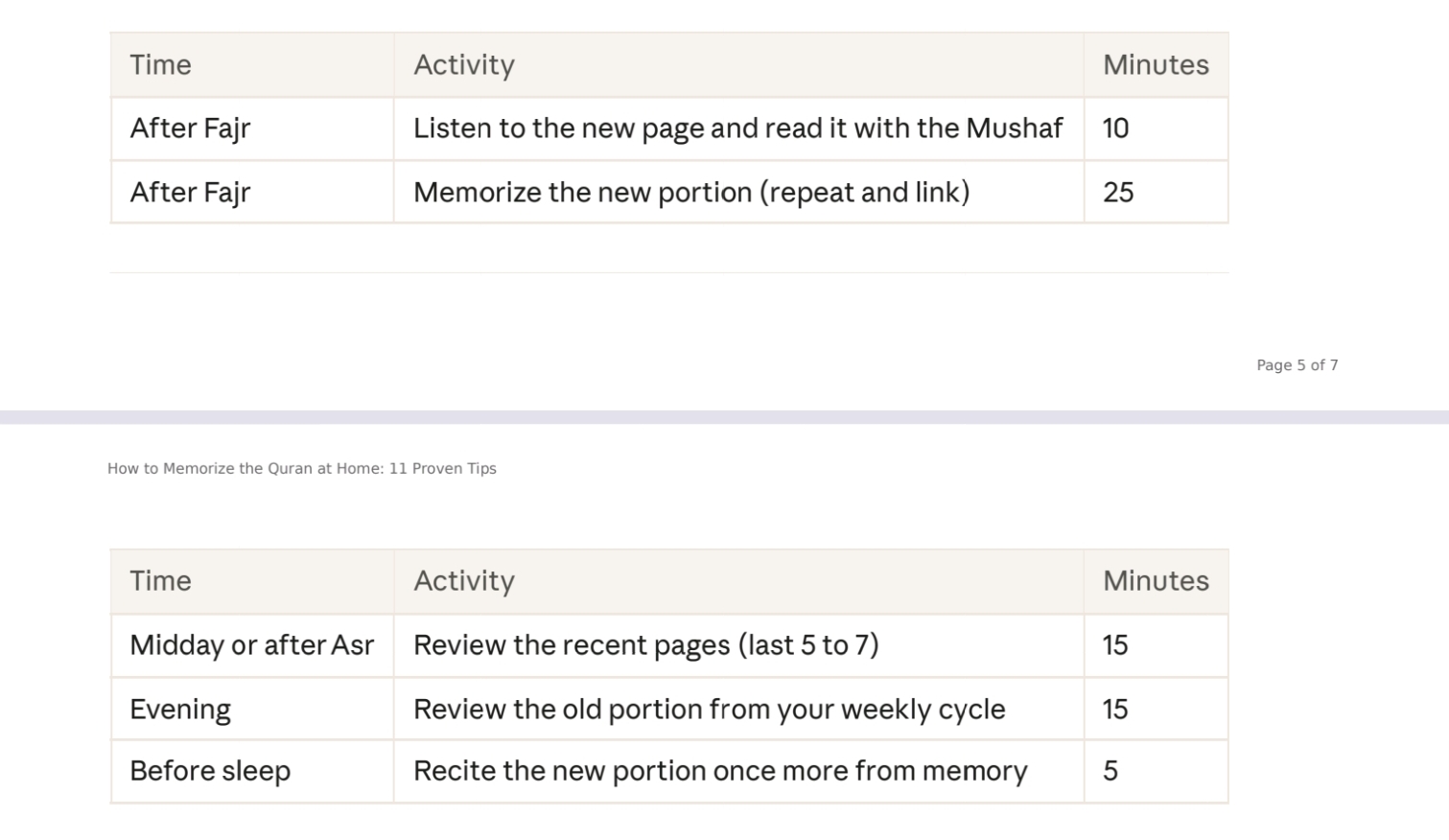
Once a week, recite your week of memorization to your teacher or partner.
Frequently Asked Questions About Memorizing the Quran at Home
Can I memorize the Quran at home without a teacher?
You can begin on your own, especially with short surahs, but a teacher is strongly recommended. Without one, mistakes in pronunciation and tajweed can settle into your memory and become hard to fix. Even one weekly session with a qualified teacher makes a big difference.
How many pages should I memorize each day?
Beginners do well with a few lines to half a page. Steady learners often reach one page a day. The right amount is the one you can keep for months while still reviewing, so start small and increase gradually.
How do I stop forgetting what I have memorized?
Use one Mushaf, review daily, and follow a written cycle that covers every portion within one to two weeks. Reciting your memorization in prayer is one of the strongest ways to keep it.
How long does it take to memorize the whole Quran?
It varies widely with your daily time, your review habits, and your teacher. Many students who work steadily for years complete it. Focus on the next page rather than on the finish line.
Can adults memorize the Quran?
Yes. Adults bring focus, understanding, and discipline. The method is the same as for children: sincere intention, steady repetition, and constant review.
Start Your Quran Memorization Journey Today
Memorizing the Quran at home comes down to a few things done every day: a sincere intention, dua, a fixed Mushaf, a quiet time and place, careful repetition, and daily review. Begin with one small portion today, and let the habit grow.
If you want a qualified teacher to guide you step by step, you can join the online Quran memorization program at Dar Ibn Abbas, where students repeat the verses with the teacher until they are firm. May Allah make the Quran the light of your heart and the companion of your days.